
About Us
Internal Complaints CommitteeWe are here to listen!!
Your safety, dignity, and peace of mind matter to us. If you have experienced or witnessed any form of sexual harassment or misconduct on campus, we, the Internal Complaints Committee (ICC) is here to support you with complete confidentiality and care.
Your Safety is Our Priority
Reach out to the ICC anytime for guidance, support, or to file a confidential report. We assure you of complete confidentiality.
You Are Not Alone, Your Concerns Matter
“No issue is too small if it makes you feel uncomfortable. Trust your instincts, we are in your corner.”
The Internal Complaints Committee (ICC) is an important initiative established to ensure a safe, secure, and respectful working environment for all employees. The committee is committed to preventing and addressing incidents of sexual harassment in the workplace while promoting equality, dignity, and mutual respect among all members of the organization.
The ICC functions in accordance with the applicable laws, including the Sexual Harassment of Women at Workplace (Prevention, Prohibition and Redressal) Act, 2013 (POSH Act) and the UGC regulations, 2015, wherever applicable. It provides a formal platform for individuals to raise concerns, report complaints, and seek appropriate assistance in a confidential, fair, and impartial manner.
The committee strives to create awareness about workplace rights, responsibilities, and preventive measures through awareness programs, sensitization initiatives, and educational activities. It ensures that every complaint is handled with sensitivity, confidentiality, and due consideration, following established procedures and applicable legal requirements.
Our mission is to foster a workplace culture built on trust, transparency, accountability, and respect, where every individual feels safe, valued, and empowered to contribute without fear of discrimination or harassment. Through continuous efforts and a commitment to fairness, the ICC aims to strengthen a positive and inclusive organizational environment for everyone.
Internal Complaints Committee Members
06 Members
Dr Neeru Kumar
Associate Professor
Department of Electronics





Three Students’ Representatives
If the matter involves students


UGC POSH Regulations 2015: Key Highlights
UGC Regulations — Harassment
Read / download the full UGC Regulations document (PDF)
1. Scope & Jurisdiction (What Is Covered?)
Who is covered
Applies to all students (undergraduate, postgraduate, doctoral, research scholars, and prospective candidates during admissions), as well as faculty, staff, interns, volunteers, and assistants.
Definition of Campus
Coverage extends beyond classrooms to include hostels, libraries, canteens, health centers, sports complexes, college transport, field trips, internships, cultural events, and off-campus academic visits.
Third-Party Harassment
Protects individuals from harassment by visitors or outsiders on campus.
2. What Constitutes Sexual Harassment?
Unwanted Acts
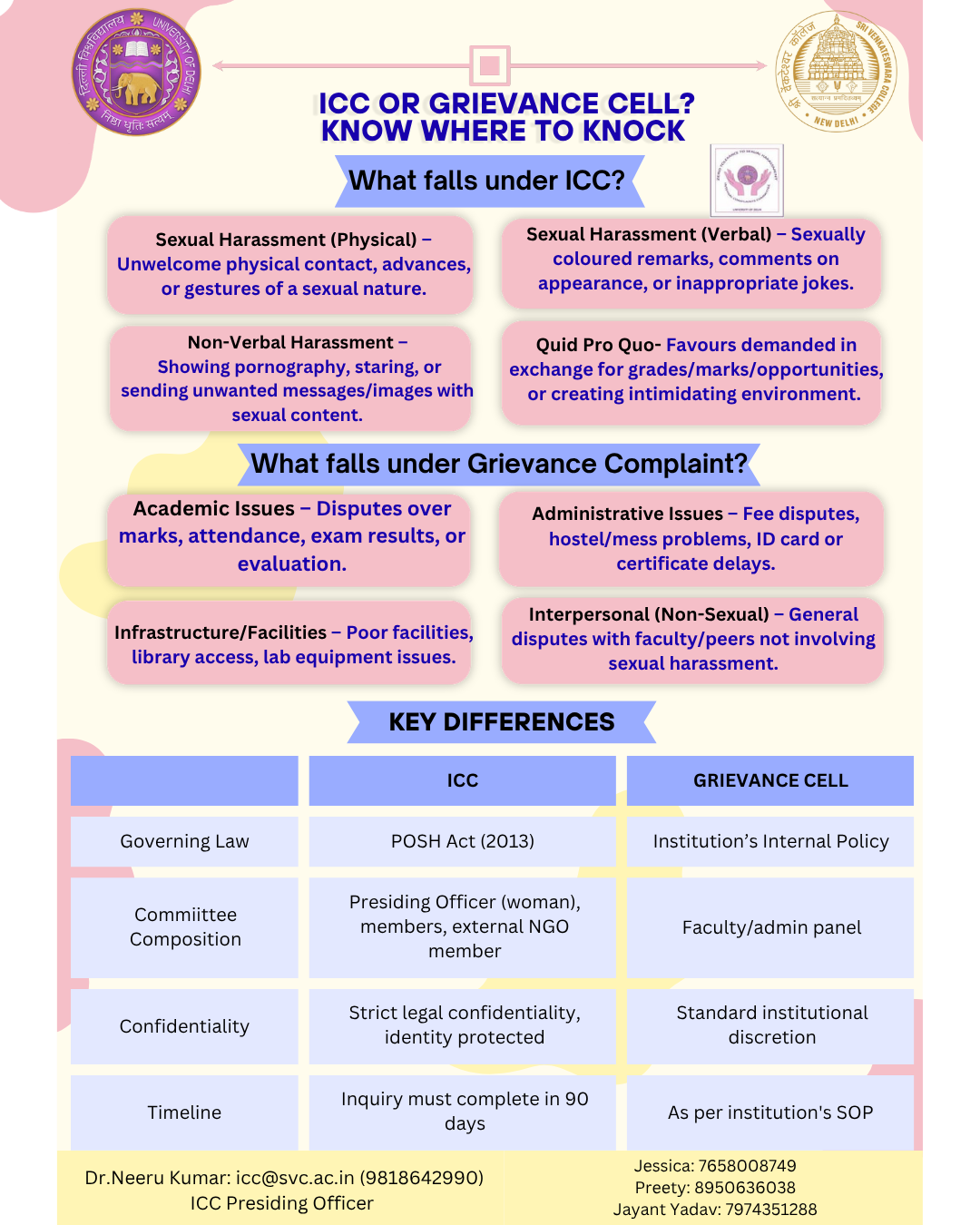
Any unwelcome physical contact, demand/request for sexual favors, sexually colored remarks, showing pornography, or unwelcome verbal/non-verbal conduct.
Quid Pro Quo
Promises of academic/career preferential treatment in exchange for sexual favors, or threats of detrimental treatment regarding present or future status.
Hostile Environment
Actions that create an intimidating, hostile, humiliating, or offensive learning/working atmosphere.
3. Composition of the ICC
A senior woman faculty member (Associate Professor/Reader or Professor level).
- 2 faculty members and 2 non-teaching staff committed to women's causes or with social/legal experience.
- 3 student representatives (UG, PG, and Research levels) elected democratically (included when a case involves students).
- 1 external member from an NGO or association working for women's rights.
At least 50% of total members must be women.
Senior administrative authorities (such as Principal, Vice-Principal, Deans, or HoDs) are excluded from ICC membership to maintain independence.
4. Complaint Filing & Timelines
Time Limit
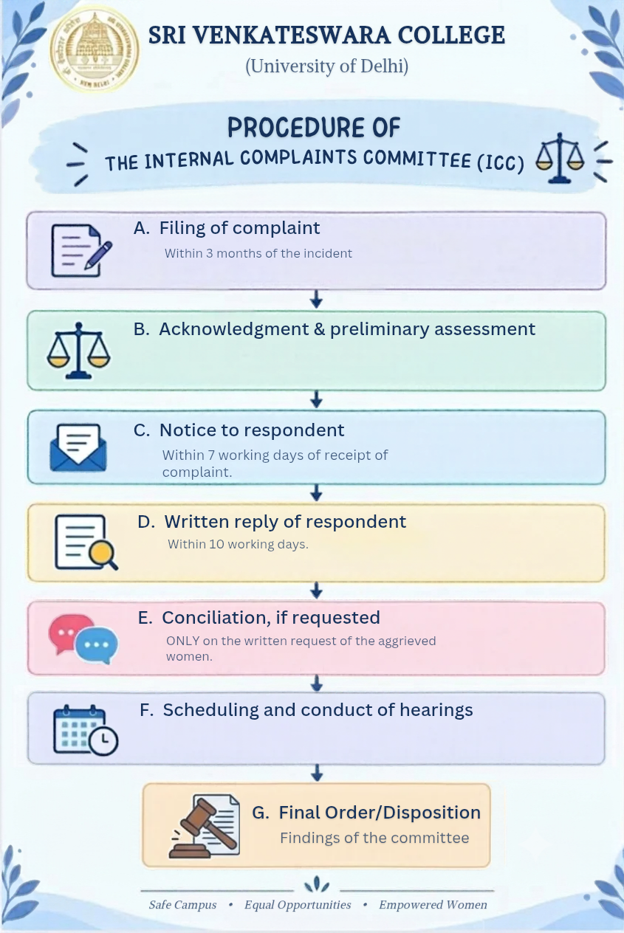
Complaints must be submitted in writing within 3 months of the incident (or last incident in a series). ICC can extend this by another 3 months under exceptional circumstances.
Filing Assistance
If unable to write, ICC members will assist in drafting the complaint. Relatives, friends, or associates may file on the victim's behalf in cases of physical/mental incapacity.
Key Process Timelines
Notice to Respondent
ICC forwards a copy of the complaint to the respondent within 7 working days.
Respondent Reply
Respondent must reply with evidence and witness lists within 10 working days.
Inquiry Completion
Inquiry must be completed within 90 calendar days.
Report Submission
Final report submitted to the Executive Authority (Principal) within 10 days of inquiry completion.
Action Implementation
Executive Authority acts on recommendations within 30 days.
Appeals
Either party can appeal findings/recommendations within 30 days of receiving the report.
5. Interim Relief & Protection During Inquiry
While an inquiry is pending, the ICC can recommend:
Transfers
Transferring the complainant or respondent to another section/department to prevent contact.
Academic/Work Protections
Restraining the respondent from evaluating or examining the complainant's performance, tests, or exams.
Leave Relief
Granting up to 3 months of leave to the aggrieved party without loss of attendance/academic status.
Restraint
Banning or restricting the offender's access to specific campus spaces if a threat exists.
6. Penalties & Consequences
| Category | Punishments |
|---|---|
| For Students |
|
| For Employees |
|
| Compensation |
|
7. Confidentiality & Safeguards
Strict Confidentiality
Identities of the complainant, respondent, and witnesses are strictly confidential and will not be disclosed publicly.
Protection Against Retaliation
Victimization or retaliation against anyone participating in an inquiry is strictly prohibited.
Protection for Genuine Complaints
Inability to produce sufficient proof does not automatically mean a complaint is false. Disciplinary action applies only if an inquiry establishes clear malicious intent or deliberate fabrication.
Gallery
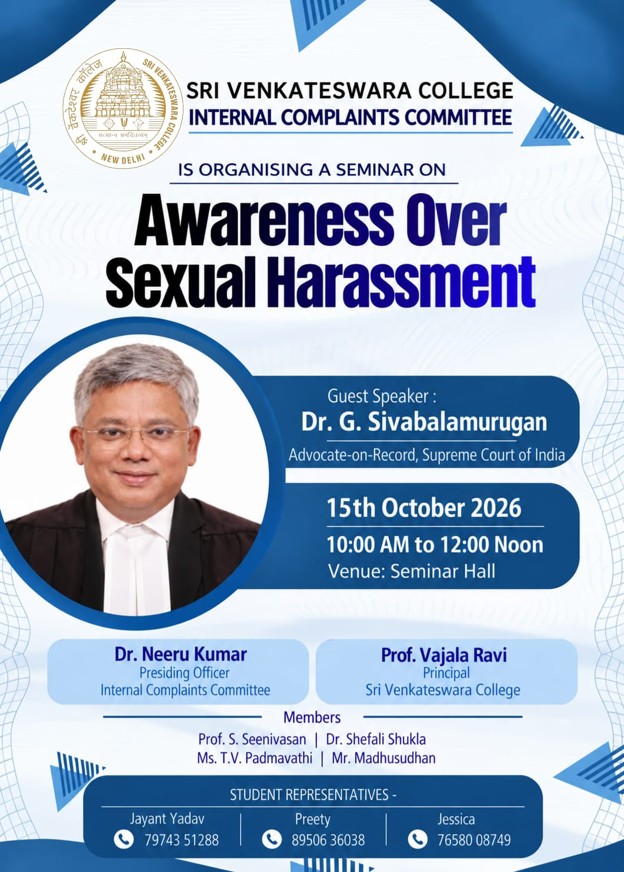
03 Posters